Out of the Box introduction: artists, activists and adventurers
 When I was 15, I went on a camp called ‘Life Skills for Teenagers with Disabilities’.
I didn’t want to go.
‘How insulting,’ I moaned at home. ‘Do they think I don’t know how to live?!’
I was being smart. Really I didn’t like being lumped together with other disabled teenagers. ‘Being lumped together’ – that’s what it felt like. How could anything positive come from that?
Yet I went to the camp and it changed my life: I got to drive a car. Me, who couldn’t run or jump and when my joints hurt could hardly walk! None of it mattered. Several people at the camp drove cars and they were paraplegics, they couldn’t walk at all. It set up a dream in my head: one day I’d have a car of my own. I’d go where I wanted, when I wanted.
Meeting other disabled or Deaf people
In this book several people talk about what it was like to meet other disabled or Deaf people. Cheryl Anton, who was Deaf, never thought she could be a teacher, until she went to the United States and saw Deaf people teach using sign language.
You’ll also find stories here about a filmmaker (Jared), a comedian (Pip), a Cook Strait voyager (Paul), a musician (Pati) and many protesters (Robert and others). There are stories about being proud to be autistic (Chanelle), playing in the Wheel Blacks (Maia), experiencing mental distress (Julie), campaigning for accessible buses (Alison) and asking big identity questions (Patrick). This could have been a book about 100 people – it was hard to keep it to 25!
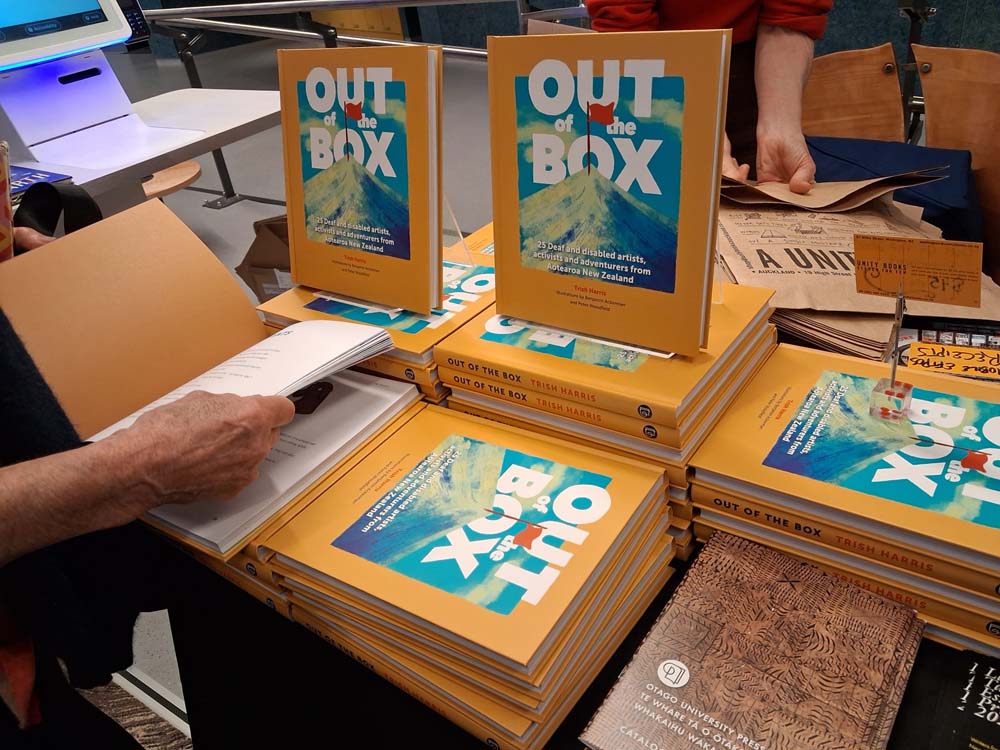
They’re artists, activists and adventurers. They’ve put a flag in the ground claiming their own space, as in the drawing on the cover. They’ve said, ‘I’m doing life my way’ and ‘this is what I need, in order to be who I am’.
Learning about their creativity and passion
As I’ve researched their lives I’ve loved learning about their creativity and passion, and I’ve cried about some of the hard things they endured. Things that never should have happened. The interesting thing is the people in this book don’t need my tears, and I get that. When I was growing up I didn’t always like it when people cried about my life or felt sad about it.
Sometimes that’s the main way people react to people with disabilities: they get sad. Or else they talk about how inspiring we are – like we’re all scaling mountains all the time, whereas in reality many of us have ordinary lives. Besides which, many of the mountains are created by our disabling world – they don’t need to be there. This book celebrates achievement, but it also highlights unnecessary mountains. Those mountains can be flattened.
A timeline of Deaf and disability history
In the second part of this book there’s a timeline that lists actions, events and achievements that make up Aotearoa New Zealand’s little-known Deaf and disability history.
I’ve learned how long it took for Deaf people to gain the right to use their own language.
I’ve learned that in te ao Māori, impairments and disability are seen differently – not viewed with the negative attitudes that shaped Aotearoa’s history in the late nineteenth and early twentieth centuries.
As Gary Williams (Ngāti Porou) says, ‘Our pūrākau, Māori sacred stories, include atua and tīpuna who had abilities others didn’t have. It was a natural part of life. Pūrākau have layers – they’re coded and can mean many things. Disabled people’s lives have often been written in code, too.’
He says Out of the Box is about unlocking codes. I love that.
Or in the words of Alice, another disabled activist I spoke to: ‘Disabled people have to pass on the secrets to one another.’
Ordinary, just like me
Secrets and codes. Going on that camp didn’t just show me that I could drive. When I met the other disabled teenagers, I saw that they were ordinary, just like me. One of the people on the camp, Paul, is in this book. He organised the camp, whipping around in his wheelchair. Maybe it was okay to use a wheelchair, I thought, and maybe one day I’ll get behind the wheel of a car.
I went on to get a modified car when I was 18. I was able to do that because politicians had passed the Disabled Persons Community Welfare Act 1975, which, at that time, entitled me to funding if I could tick all the boxes on the application form. Luckily, I could.
Boxes to tick. Boxes to break out of.
Welcome to the stories of these 25 artists, activists and adventurers and the history that shows how they got here. I hope the stories and the events that surround them open doors in your head – making you feel you belong to a wider group or inspiring you to help build a world where needs are met and we all belong.
Mauri ora,
Trish Harris


 Disabled Artists Aotearoa